
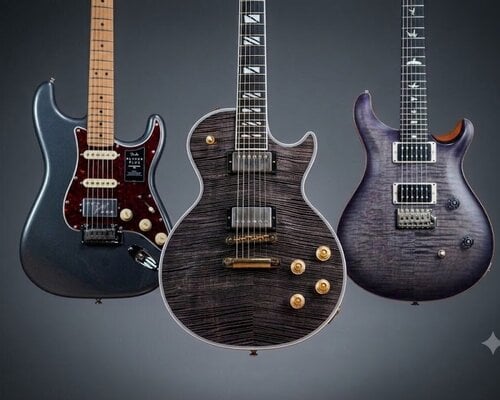
The short answer is due to string tension !
For a given string gauge and pitch, a longer scale length requires more tension to bring the string up to the same note. More tension makes the string feel stiffer when bending or applying vibrato.
The Physics
The tension equation is:
T∝(L×f)2T \propto (L \times f)^2T∝(L×f)2Where:
- T = string tension
- L = scale length
- f = frequency (pitch)
Since the pitch remains the same, tension increases with the square of the scale length.
Fender vs. Gibson Example
Typical scale lengths:
- Fender: 25.5 inches
- Gibson: 24.75 inches
The tension ratio is:
(25.524.75)2=1.062\left(\frac{25.5}{24.75}\right)^2 = 1.062(24.7525.5)2=1.062A Fender therefore has approximately 6.2% more string tension than a Gibson when using the same:
- string gauge
- tuning
- string construction
Real-World Example
A .010–.046 set might have:
| String | Gibson (24.75") | Fender (25.5") |
|---|---|---|
| High E (.010) | ~15.4 lbs | ~16.3 lbs |
| Low E (.046) | ~16.8 lbs | ~17.8 lbs |
That extra pound of tension across each string is enough that most players immediately notice:
Fender feel
- Tighter
- Snappier attack
- More resistance to bending
- Slightly brighter tone
Gibson feel
- Slacker
- Easier bends
- Wider vibrato
- Slightly warmer and thicker feel
Why the Difference Feels Larger Than 6%
The perceived stiffness is influenced by more than just tension:
- String length behind the nut and bridge
- Break angle over the nut and bridge
- Neck construction
- Action height
- Fret size
- Tailpiece design (especially on Gibson stop-tail guitars)
All of these factors contribute to what players call compliance, or how easy the string feels to bend.
Compensating for Scale Length
Many players adjust gauges to equalize the feel:
| Guitar | Common Gauge |
|---|---|
| Fender 25.5" | .009–.042 |
| Gibson 24.75" | .010–.046 |
A set of .009s on a Fender often feels very similar to .010s on a Gibson.
This is why players moving between a Fender and a Gibson frequently change string gauges to maintain the same playing feel.
The difference is primarily due to string tension. A longer scale guitar requires more tension to bring the same gauge string to the same pitch, so the strings feel stiffer and resist bending more.
The Physics
String tension is proportional to the square of the scale length:
T∝(L×f)2T \propto (L \times f)^2T∝(L×f)2Where:
- T = string tension
- L = scale length
- f = frequency (pitch)
Since the pitch remains the same, increasing the scale length increases the tension.
Fender vs. Gibson Scale Lengths
Typical scale lengths:
- Fender: 25.5 inches
- Gibson: 24.75 inches
The tension ratio is:
(25.524.75)2=1.062\left(\frac{25.5}{24.75}\right)^2 = 1.062(24.7525.5)2=1.062A Fender therefore requires approximately 6.2% more tension than a Gibson for the same strings and tuning.
Typical High-E String Tensions
| Gauge | Gibson 24.75" | Fender 25.5" |
|---|---|---|
| .009" | ~12.5 lbs | ~13.3 lbs |
| .0095" | ~13.8 lbs | ~14.7 lbs |
| .010" | ~15.4 lbs | ~16.3 lbs |
The .0095" set sits almost exactly between .009s and .010s and has become popular because it provides:
- Slightly more body and tuning stability than .009s
- Easier bending than .010s
- A compromise between the two feels
Matching Feel Between Fender and Gibson
Approximate equivalents:
| Guitar | Comparable Feel |
|---|---|
| Fender 25.5" with .009" | Gibson 24.75" with .0095" |
| Fender 25.5" with .0095" | Gibson 24.75" with light .010s |
| Fender 25.5" with .010" | Gibson 24.75" with .0105–.011" |
Many players who find .009s too light and .010s too stiff on a Fender settle on .0095–.044 or .0095–.046 sets.
Common String Choices
| Guitar | Light | Medium | Traditional |
|---|---|---|---|
| Fender 25.5" | .009–.042 | .0095–.044 | .010–.046 |
| Gibson 24.75" | .0095–.044 | .010–.046 | .011–.049 |
Why the Difference Feels Greater Than 6%
The perceived stiffness is also affected by:
- String length behind the nut and bridge
- Break angle over the nut and bridge
- Bridge and tailpiece design
- Action height
- Neck construction
- Fret size
These factors affect the compliance of the string system, which is why two guitars with identical measured tensions can still feel noticeably different.
For many players, a .0095 set on a 25.5" Fender provides a feel very close to a .010 set on a 24.75" Gibson, which is why .0095s have become such a popular compromise gauge.
Why Do the Same Guitar Strings Feel Stiffer on a Fender Than on a Gibson?
The primary reason is string tension.
A longer-scale guitar requires more tension to bring the same string gauge to the same pitch. More tension means the strings feel tighter, resist bending more, and generally have a stiffer playing feel.
The Physics
String tension is proportional to the square of the scale length:
T∝(L×f)2T \propto (L \times f)^2T∝(L×f)2Where:
- T = String tension
- L = Scale length
- f = Frequency (pitch)
Because the pitch remains the same, increasing the scale length increases the required tension.
Fender vs. Gibson Scale Lengths
Typical scale lengths:
- Fender: 25.5 inches
- Gibson: 24.75 inches
The tension ratio is:
(25.524.75)2=1.062\left(\frac{25.5}{24.75}\right)^2 = 1.062(24.7525.5)2=1.062This means a Fender requires approximately 6.2% more tension than a Gibson when using the same strings and tuning.
High-E String Tension Comparison
Approximate tensions for the high-E string tuned to E4:
| Gauge | Gibson 24.75" | Fender 25.5" | Increase |
|---|---|---|---|
| .009 | 12.5 lbs | 13.3 lbs | +6.2% |
| .0095 | 13.8 lbs | 14.7 lbs | +6.2% |
| .010 | 15.4 lbs | 16.3 lbs | +6.2% |
| .011 | 18.6 lbs | 19.7 lbs | +6.2% |
Even though the percentage increase remains constant, the absolute difference becomes more noticeable as the strings get heavier.
Complete Set Tension Comparison
Approximate total tensions for standard six-string sets in E tuning:
| String Set | Gibson 24.75" | Fender 25.5" |
|---|---|---|
| .009–.042 | ~84 lbs | ~89 lbs |
| .0095–.044 | ~90 lbs | ~95 lbs |
| .010–.046 | ~99 lbs | ~105 lbs |
| .011–.049 | ~119 lbs | ~126 lbs |
The difference between a .009 set and an .011 set is substantial—approximately 35 to 40 pounds of total tension.
How the Different Gauges Feel
.009–.042
- Very easy bends
- Light touch
- Fast vibrato
- Less finger fatigue
- Slightly thinner tone and attack
- Popular with players who use extensive bending
Typical choice:
- Fender: very slinky
- Gibson: extremely slinky
.0095–.044
- Middle ground between .009s and .010s
- Easier bending than .010s
- More tuning stability than .009s
- Slightly fuller tone
Typical choice:
- Fender: balanced feel
- Gibson: soft and easy to play
This has become one of the most popular modern gauges because it combines many of the advantages of both .009s and .010s.
.010–.046
- Industry standard for many players
- Good balance of tone and playability
- Firmer attack
- Better tuning stability
- Stronger fundamental note
Typical choice:
- Fender: medium tension
- Gibson: slightly slinky but substantial
.011–.049
- Noticeably stiffer
- More resistance to bending
- Bigger tone and stronger low end
- Excellent tuning stability
- Increased sustain and dynamic range
Typical choice:
- Fender: quite firm
- Gibson: similar to .010s on a Fender
Comparable Feel Between Fender and Gibson
| Fender 25.5" | Similar Feel on Gibson 24.75" |
|---|---|
| .009 | .0095 |
| .0095 | Light .010 |
| .010 | .0105–.011 |
| .011 | .0115–.012 |
This is why many players who switch between the two brands use different gauges on each guitar.
Examples:
- Fender with .009 → Gibson with .0095
- Fender with .0095 → Gibson with .010
- Fender with .010 → Gibson with .011
Why the Difference Feels Larger Than 6%
String tension is only part of the story. The perceived stiffness is also influenced by:
- String length behind the nut and bridge
- Break angle over the nut and bridge
- Bridge and tailpiece design
- Neck construction
- Action height
- Fret size
- Overall string compliance
These factors explain why two guitars with nearly identical measured tensions can still feel dramatically different.
Practical Rule of Thumb
| Desired Feel | Fender | Gibson |
|---|---|---|
| Very slinky | .009 | .0095 |
| Balanced | .0095 | .010 |
| Traditional | .010 | .011 |
| Heavy | .011 | .012 |
For many players, a .0095 set on a 25.5" Fender feels remarkably close to a .010 set on a 24.75" Gibson, while a .011 set on a Gibson feels very similar to a .010 set on a Fender.
Notice: This article was generated with the help of Claude & Gemini AI, reviewed & editing by John Mann.